
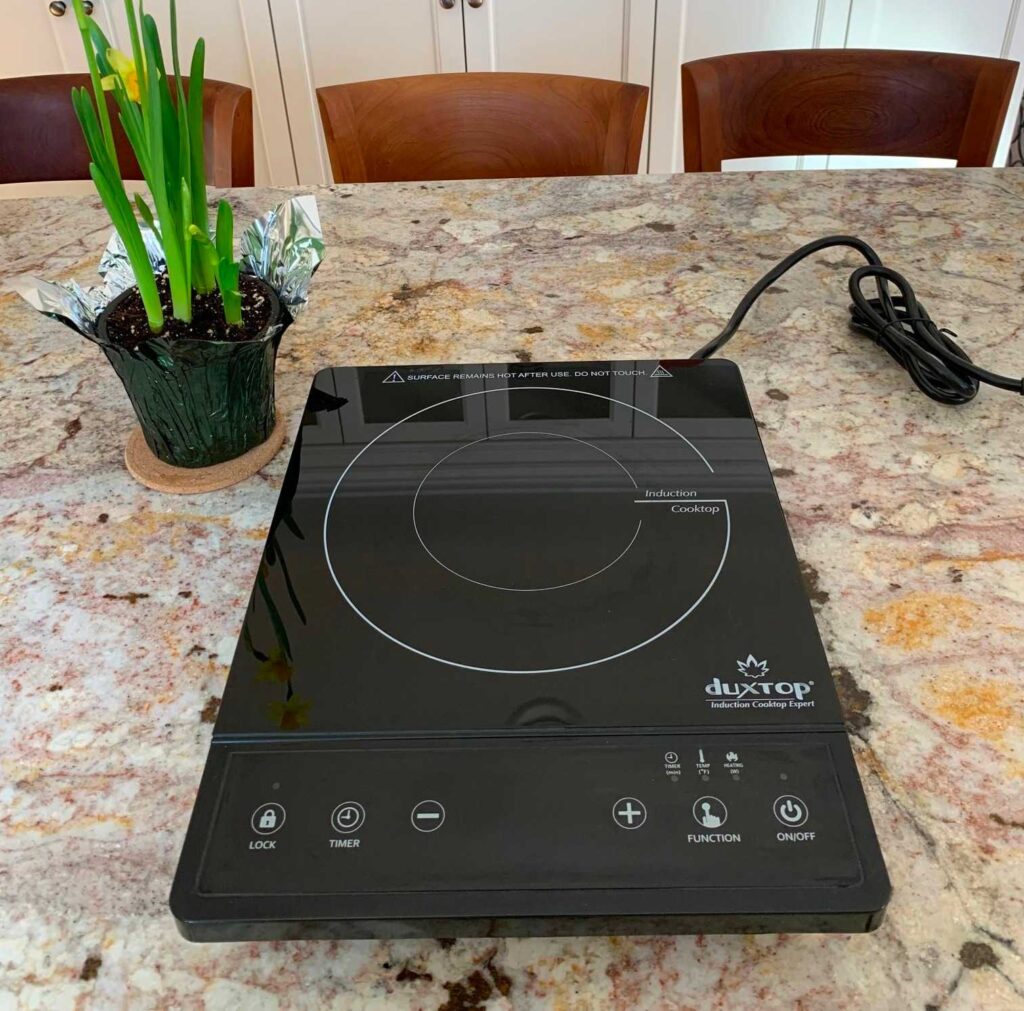
Switching from gas or propane to electric induction cooking is a great way to ‘clean up and green up’ your cooking. With induction cooking there are no open flames, unburned gas or other harmful combustion byproducts in your living space. With induction you have instantaneous control over the temperature of your cookware, unlike the old electric resistance ‘coil type’ cooktops. You also have a much wider range and much more precise, temperature control, for tasks from boiling water quickly to slowly steaming rice. You also have a flat, easy to clean cooktop surface.
An induction cooktop does not heat the cooking surface, instead it heats the cookware directly. The cookware must be ferromagnetic. To test your existing cookware, you simply obtain a (typically free) cookware testing magnet from an appliance store. If it sticks to the bottom, the cookware will work on an induction cooktop. There are many types of induction compatible cookware, much of your existing cookware may work. Adapter plates are available for non-ferromagnetic cookware. Results with these types of plates vary.
Since you control the temperature of the cookware directly, you can very quickly change the cookware temperature. Since you are heating the cookware directly induction is more efficient, using somewhat less energy than an electric resistance cooktop, and much less energy than a gas cooktop. This higher efficiency translates into both lower energy and lower greenhouse gas emissions. Since natural gas cooktops have methane leakage which has been measured in several studies, even when they are off (see Deep Dive references), people with respiratory issues such as asthma may benefit substantially by removing this source of indoor air pollution from their home.
Because of the many advantages, restaurant kitchens are switching from gas to induction cooktops.
Since induction cooktops use a magnetic field to heat cookware, those with pacemakers should check with their doctor, since there appears to be a variety of medical opinions regarding safe practices.